

Now 4.3% Yes · $308K volume · Updated 2026-08-04 12:07:04 UTC · open (anchor was 8.6% · -4.3 pp)
This summer, NATO and Russia continue to navigate heightened tensions marked by increased troop movements near Eastern Europe and fraught diplomatic communications.
Recent statements from NATO officials underscore a cautious approach amid concerns of potential military escalation. Meanwhile, Russia maintains a posture signaling readiness despite calls for de-escalation from multiple international actors.
The geopolitical landscape between NATO and Russia has grown increasingly complex in recent months. Russian troop deployments near Ukraine and the Baltic states, combined with NATO’s bolstered defenses and military exercises in Eastern Europe, contribute to an atmosphere charged with uncertainty. Diplomatic efforts aimed at reducing tensions have experienced setbacks, with key meetings producing limited agreements and persistent mutual distrust.
Historical context underscores the sensitivity of this region; NATO’s expansion eastward and Russia’s insistence on strategic buffer zones fuel the potential for conflict. Economic sanctions. Cyber confrontations, and proxy disputes have long characterized this rivalry, but direct military clashes have remained a low-probability outcome—until recent months, where rhetoric and maneuvers suggest a shift towards heightened risk.
The approaching August 31, 2026, deadline for a possible NATO-Russia military clash carries fresh significance as diplomatic calendars, military readiness schedules, and political leadership terms converge. International observers note that unresolved disputes over territorial integrity and alliance commitments leave open the possibility of rapid escalation should incidents on the ground spiral out of control.
Traders on Polymarket price the likelihood of a NATO and Russia military clash by August 31, 2026, at 8.6% Yes on $97K in volume. This stands in contrast to a higher 26.5% Yes on a similar contract for a clash by December 31. 2026, which has attracted $972K in volume, more substantial market focus on a later timeframe. The overall event volume reaches $3.33M with 978 unique traders participating across 25,835 trades. No significant whale activity is detected in the short-term August contract, suggesting cautious, distributed positioning by market participants. Notably, three contracts tied to earlier deadlines have been eliminated as those dates passed without incident.
A Yes outcome for the August 31 market would mean a military clash between NATO and Russia occurs before or on that date. The stakes are high, potentially reshaping international security policies and triggering widespread geopolitical consequences. The lower probability priced in for the near term compared with the December contract implies that traders see the risk as rising over time rather than immediate. This aligns with ongoing international assessments that point to a volatile but not yet explosive situation.
At a glance
| Market | NATO x Russia military clash by August 31, 2026? |
|---|---|
| Yes | 4.3% |
| Volume | $308K |
| Whale net 24h | +$67.4K |
| Whale net 7d | +$78.7K |
| Closes | 2026-08-31 |
| Days left | 27 |
| Unique traders | 1,085 |
Related markets
| Market | Yes % | Volume |
|---|---|---|
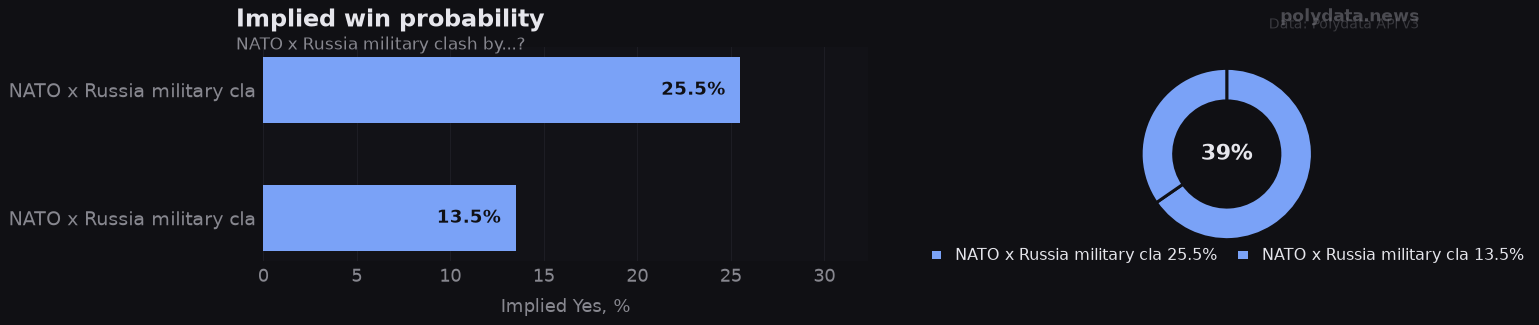
| NATO x Russia military clash by December 31, 2026? | 25.5% | $1.08M |
| NATO x Russia military clash by October 31, 2026? | 13.5% | $62.3K |
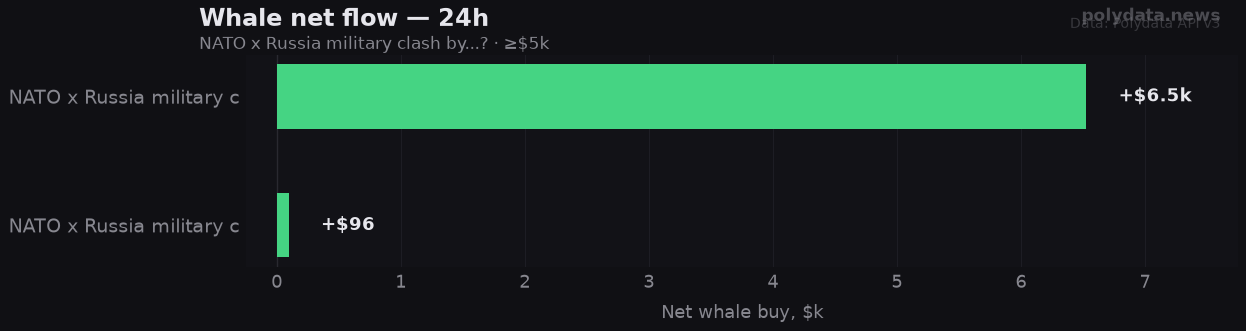
Whale net flow 24h — open markets
| Market | Whale buy | Whale sell | Net | Whales |
|---|---|---|---|---|
| NATO x Russia military clash by December 31, 2026? | $14.4K | $7.9K | +$6.5K | 23 |
| NATO x Russia military clash by October 31, 2026? | $174 | $77 | +$96 | 8 |
Other outcomes (near zero)
| Outcome | Yes % | Volume |
|---|---|---|
| NATO x Russia military clash by June 30, 2026? | 0.0% | $1.19M |
| NATO x Russia military clash in 2025? | 0.0% | $630.3K |
| NATO x Russia military clash by March 31, 2026? | 0.0% | $539.4K |
FAQ
What is the Polymarket question?
NATO x Russia military clash by August 31, 2026?
What is the current Yes price and volume?
As of 2026-08-04, the market prices Yes at 4.3% with $308K in traded volume.
When does this market close?
The listed end date is 2026-08-31 (see Polymarket for the exact resolution window).
Source: Date 2026-08-04. On-chain figures are public. Realized PnL is computed over resolved markets only and excludes open positions, so it is conservative versus the Polymarket UI. This is not investment advice.